When to Visit Etna, and What to Wear at Altitude
Etna can be visited in every month of the year. What changes is not whether you can go, but what the mountain is like when you get there, which stages are running in which form, and what you need on your back. The single most common mistake is dressing for the coast: people leave Catania in shorts and step off the cable car into wind and cold.
This guide explains how the seasons change a visit, which days to avoid if you rely on the bus, how an active volcano affects your plans, and what to wear at each stage of the climb.
One morning, three climates
The reason Etna needs its own packing list is the height you gain in a short time.
On the south side, the road takes you to Rifugio Sapienza at 1,910 m. The cable car then lifts you from 1,920 m to 2,500 m. The 4x4 bus — a snowcat in winter — continues to 2,800 m, and the short guided walk ends at 3,000 m. A guided summit hike goes higher still, towards 3,400 m.
That is a climb of several thousand metres from the coast in a couple of hours, most of it without any effort on your part. Your body does not have time to adjust, and the air around you changes faster than you expect. The guides’ own advice is blunt: even in summer it can be cold at altitude. Plan your clothes for the top, not the bottom.
Etna season by season
Summer
Summer is the busiest season and the easiest one to plan. The upper transfer runs as a 4x4 bus between 2,500 m and 2,800 m, the days are long, and the full range of tours operates, including the evening ones.
What catches people out in summer is the contrast. The coast can be hot, and it is tempting to set off in light clothes. The recommendation from the guides for summer is light clothing in layers, plus sunglasses and sun cream — layers because it is cooler at the top, and sun protection because the sun at altitude is strong and the dark volcanic ground offers no shade.
Summer is also the season for sunset. The sunset jeep tour from Catania runs about 5–5.5 hours and ends with sunset at about 2,000 m, after stops at old eruptive vents, a lava-flow cave (helmet and torch provided) and local tastings in Zafferana Etnea. The public bus cannot give you that: it leaves Rifugio Sapienza at 16:30.
Spring and autumn
Spring and autumn sit between the two extremes. The mountain is quieter than in high summer, and the landscape on the lower slopes is at its most varied. The trade-off is that conditions at the top are less predictable, and the difference between a clear day and a closed upper station can come down to the wind on the morning you go.
If you are visiting in these seasons, keep your Etna day flexible if you can, and choose products whose cancellation terms cover weather closures.
Winter
In winter the upper slopes hold snow, and the clearest sign of it is the upper transfer: the 4x4 bus is replaced by a snowcat between 2,500 m and 2,800 m. The guides’ advice changes accordingly, to full winter technical clothing.
Winter has real rewards. A snow-covered volcano above a green coast is one of the great views of Sicily, and the tourist areas are usually quieter than in summer. But winter is also when the upper stages are most dependent on the weather, so a winter visit needs more flexibility, not less.
The days to avoid if you rely on the bus
The AST bus from Catania to Rifugio Sapienza runs every day except 25 December, 1 January, 1 May, 15 August and Easter Sunday. If you are travelling without a car on any of those days, you will need a tour or a taxi.
The other date-related issue is on the north side. New parking rules at Piano Provenzana, announced in December 2025, provide 22 spaces for coaches and 10 for campers, and local reporting warned that at weekends and on public holidays that may not be enough. If you are heading to the north side at a weekend, go early.
Morning or evening?
Most people visit Etna in the morning, and there is a good reason for it: if the upper stages close later in the day because of wind or cloud, you will already have been up. A morning visit also fits the bus, which reaches Rifugio Sapienza at about 10:15 and leaves again at 16:30.
An evening visit is a different experience. The light is softer, the colours of the old lava flows come out, and sunset from the mountain’s slopes is spectacular on a clear day. The practical way to do it is a sunset tour, because driving the winding road down in the dark after a long day is not most people’s idea of fun.
A reasonable rule: if the cable car and the upper stages are your priority, go in the morning. If the atmosphere and the light are your priority, book a sunset tour.
Living with an active volcano
Etna is not a dormant mountain with a view. It is active, and that shapes every visit in ways that have nothing to do with the season.
The mountain changes shape. In 2021, after about 50 paroxysms at the South-East Crater, INGV reported a record height of 3,357 m. By July 2024 it measured the eastern rim of the Voragine crater at about 3,369 m, the greatest height ever measured on Etna. Guidebook heights go out of date; the mountain keeps building itself.
Access is managed. Since August 2010, ordinances of the Prefecture of Catania have closed the summit zone from 2,920 m at Torre del Filosofo on the south side and from 2,990 m at Punta Lucia on the north side. Visits to the summit craters must be accompanied by qualified alpine or volcanological guides, and access changes with volcanic activity.
Closures happen at short notice. Wind, cloud and volcanic activity can close the upper slopes with little warning. That is not a reason to stay away — it is a reason to plan for it.
What that means in practice:
- Build in slack. If Etna is a priority, do not schedule it on your last day in Sicily.
- Check the day before and the morning of. Conditions at the top are what matter, not the forecast for Catania.
- Read cancellation terms. Each product sets its own terms for weather and volcanic closures.
- Let the guide decide. On guided hikes, the guide chooses the route on the day based on the state of the craters.
What to wear, stage by stage
At Rifugio Sapienza and the Silvestri craters (about 1,900 m)
The refuge area is the mildest part of the visit, but it is still well above the coast. A light layer on top of whatever you wore on the way up is usually enough in summer; in winter you will want warm clothing from the moment you get out of the car. Wear shoes with a proper sole: the paths around the Silvestri craters are loose cinder, and it gets into light shoes and sandals immediately.
At the upper cable car station (2,500 m)
This is where most visitors feel the difference. The ground is bare and exposed, and wind can make it feel much colder than the temperature suggests. Bring a windproof layer. If you have not brought one, windproof jackets, boots and poles can be hired at altitude.
On the 4x4 track and the walk to 3,000 m
The short walk is on volcanic sand and ash. Footwear matters more than anything else here: closed shoes with a good grip, ideally walking boots. Layers you can open or close as you warm up on the walk and cool down when you stop are better than one heavy coat.
On a guided summit hike (towards 3,400 m)
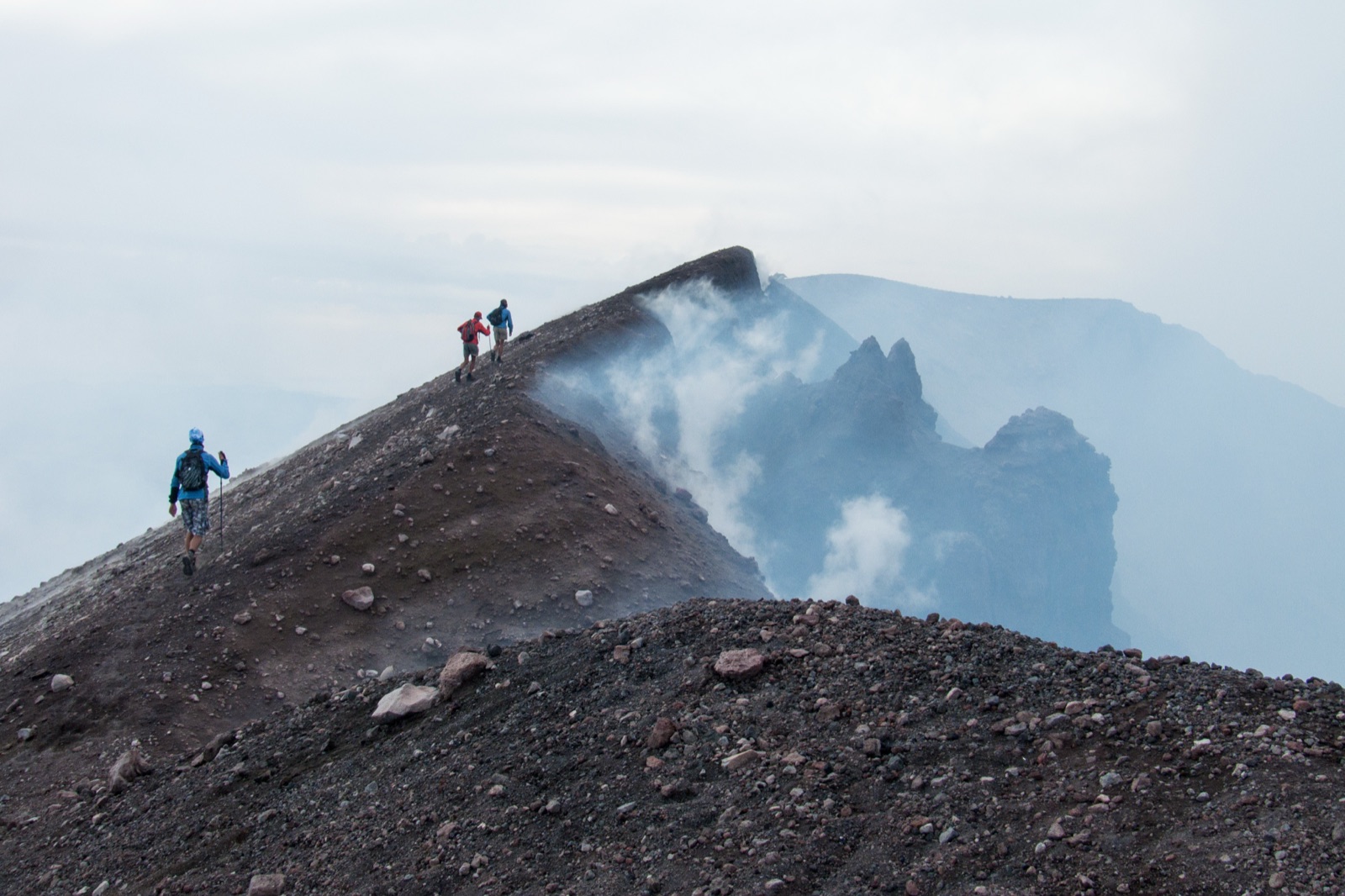
A summit hike is a real mountain walk on loose ground at altitude. Walking boots, several layers, a windproof and waterproof outer layer, a hat and gloves outside the summer months, and sun protection all year. Your guide will tell you what the group needs on the day; follow that advice over anything written here.
A packing list for an Etna day
For a standard visit — cable car, perhaps the 4x4 and the walk to 3,000 m — this covers you in most seasons:
- Closed shoes with a good sole, or walking boots.
- A warm layer (fleece or similar), even in summer.
- A windproof jacket.
- Sunglasses and sun cream, especially in summer.
- A hat.
- Water and a snack, because the day at altitude is longer and more tiring than it looks.
- A small backpack, so your hands are free on loose ground.
- In winter: full winter clothing, including gloves and a warm hat.
Visiting with children, older relatives or limited mobility
Etna is more accessible than its reputation suggests, as long as you pick the right stages.
- The cable car and the 4x4 track do the climbing for you. The operator describes the 4x4 stage as suitable for families, older visitors and people with reduced mobility, which makes the staged ascent the obvious choice for a mixed group.
- The Silvestri craters are close to the car park and the bus stop at Rifugio Sapienza, so you can turn back at any point.
- The short walk to 3,000 m and the summit hikes are where it gets harder: loose ground, altitude and wind. If anyone in the group is unsure, let them wait at the end of the 4x4 track or the upper station while the others walk on.
For children in particular, the cold is the thing to plan for. They feel wind and altitude more quickly than adults and are less likely to say so until they are already miserable. Pack an extra layer for them even in summer.
Cloud, views and photographs
On many days a layer of cloud sits on Etna’s slopes, and whether you are above it, in it or below it makes a huge difference to what you see.
- Above the cloud, the view is one of the best on the island: a white sea below you with the summit area rising behind.
- In the cloud, visibility can drop to a few metres, and the upper stages may close for safety.
- Below the cloud, the lower slopes and the Silvestri craters are clear, but the summit area is hidden.
Because the cloud moves through the day, the best approach is to look at the mountain itself — the operators’ webcams and the view from the coast — rather than the forecast for the city. If the top is clear first thing, go; if it is buried, consider the lower slopes, the craters near the refuge or a later tour.
For photographs, the low sun of early morning and evening brings out the texture of the lava flows and the colours of the old cones. Midday light on black volcanic ground is harsh, so if photography matters to you, the sunset tour is worth a look.
One day on Etna or two?
For most visitors one day is enough: the cable car and the upper stages in the morning, the Silvestri craters on the way down, and the rest of the day for something else. Two days make sense if:
- You want both sides. The south side for the cable car, the north side for a quieter guided walk or the Alcantara Gorges.
- You want the summit area and a back-up. A guided summit hike booked for one day, with a second day free in case it is cancelled.
- You want both a morning and a sunset visit. The light and the atmosphere are different enough to justify it.
Planning around the rest of your trip
Because the weather at the top can close the upper stages, Etna works best as a flexible item in your plans rather than a fixed appointment.
- Put Etna early in your stay. If the first attempt is cancelled, you have time for a second.
- Pair it with something that does not depend on the summit. The full-day tour to Etna and the Alcantara Gorges spends much of its time on the northern slope and in the gorges, which makes it less vulnerable to an upper-station closure.
- Keep the sunset option in reserve. If the morning is cloudy, an evening tour is sometimes the better bet.
Frequently asked questions
What is the best time of year to visit Etna?
It depends on what you want. Summer has the full range of tours, the 4x4 bus on the upper track and sunset tours; winter has snow on the upper slopes, a snowcat instead of the 4x4 and far fewer people. Spring and autumn sit in between, with more changeable conditions at the top.
Is it cold at the top of Etna in summer?
It can be. The guides’ advice is that even in summer temperatures at altitude can be low, so bring light layers — plus sunglasses and sun cream, because the sun is strong.
What should I wear to go up Etna?
Closed shoes or walking boots, layers, a windproof jacket, sunglasses and sun cream. In winter, full winter technical clothing. Jackets, boots and poles can be hired at altitude if you arrive without them.
Does the bus to Etna run every day?
Every day except 25 December, 1 January, 1 May, 15 August and Easter Sunday. It leaves Catania at 8:15 and returns from Rifugio Sapienza at 16:30.
Can Etna be closed because of eruptions?
Yes. Wind, cloud and volcanic activity can close the upper slopes at short notice, and access to the summit area changes with volcanic activity. Build flexibility into your plans and check each product’s cancellation terms.
Can I see the sunset from Etna?
Yes, on a sunset tour. The sunset jeep tour from Catania ends with sunset at about 2,000 m. The public bus leaves the mountain at 16:30, too early for sunset.