History
Mount Etna Eruptions: The Big Ones and What They Mean for a Visit
Mount Etna is one of the most active volcanoes on Earth. UNESCO calls it the most active stratovolcano in the world, with at least 2,700 years of its activity on record. Yet its eruptions rarely threaten lives: the Civil Protection Department explains that Etna’s lava is too slow and viscous to endanger people, although it destroys any building in its path.
For a visitor, what an eruption changes is access. When the volcano is active, the summit zone can be closed by ordinance, guided walks are rerouted or cancelled, and ash blown south can shut Catania airport, as it did for three days at the end of September 2026. This article explains how Etna erupts, walks through the great eruptions from 1669 to the busy summer of 2026, shows how INGV (Italy’s national institute of geophysics and volcanology) watches it, and sets out what an eruption means on the day you planned to go up.
The short answer
- How often: summit activity can run for years with few breaks, and flank eruptions have come about every 2 years on average over the last 40 years.
- What kinds: explosions and lava fountains at the summit craters; lava flows from fissures on the flanks.
- The most destructive: 1669, when lava reached Catania and the sea. The only town destroyed since the eighteenth century was Mascali, in 1928.
- Recently: Etna was very active through the summer and autumn of 2026. When this article was checked at the end of September 2026, the Civil Protection Department’s page gave the alert level as yellow.
- For your visit: eruptions close the upper mountain far more often than they endanger visitors, so keep the day flexible.
How Etna erupts
Etna has two broad kinds of eruption, and they affect a visit differently.
Summit eruptions: explosions and lava fountains
There are four craters at the top of the mountain, each about 200 m across. The Voragine and the Bocca Nuova formed inside the old Central Crater in 1945 and 1968; the North-East Crater has existed since 1911; and the South-East Crater, born in 1971, is the youngest and has recently been the most active. About a century ago the Central Crater was the only one, so the summit you see today is young and still changing.
The most common activity is Strombolian. INGV describes it as the often rhythmic ejection of glowing scraps of magma, from a few metres to hundreds of metres high. When it intensifies it can turn into lava fountains, jets of glowing material a few hundred metres tall, and in the most violent episodes a column of gas and ash rises several kilometres into the sky.
These short, violent episodes are called paroxysms. They usually last a few hours at most, but they tend to come in series: about 150 between 1995 and 2001, more than 40 between 2011 and 2015, and about 50 at the South-East Crater from 16 February 2021. Summit activity also builds the mountain. Between 2011 and 2013 a run of paroxysms raised a new cone more than 200 metres high on the flank of the South-East Crater. After the 2021 series INGV measured a record height of 3,357 m, and in July 2024 it put the eastern rim of the Voragine at about 3,369 m, the highest point ever measured on Etna.
Flank eruptions: fissures and lava flows
The other kind of eruption breaks out on the mountain’s sides. Magma forces its way along a fracture, a line of vents opens (often a row of small cones that locals call a bottoniera, a row of buttons) and lava pours downhill. Flank eruptions can start anywhere from near the summit to a few hundred metres above sea level. The gaps between them range from a few months to more than 20 years, and an eruption can last a few hours or more than a year: 472 days in 1991–1993 and 419 days in 2008–2009, in INGV’s figures.
These are the eruptions that have buried towns, because they can start low on the slopes, close to villages and farmland. INGV notes that the flank eruptions of 2001 and 2002–2003 produced large amounts of ash, lapilli, bombs and blocks, and that ash fall in a flank eruption can go on for weeks or months, whereas a summit paroxysm is over in hours.
Why lava is rarely what kills
On Etna, lava is a threat to property rather than to life. INGV’s hazard summary says the flows move slowly enough for people to be evacuated, though the buildings in their way are lost, and pyroclastic flows, the fast, scorching avalanches that make some volcanoes so deadly, are very rare here. That does not make Etna harmless. It can be strongly explosive, as in the Plinian eruption of 122 BC, and ash is the everyday nuisance: it can coat roads several centimetres deep, the finest particles irritate eyes and airways, and when it falls on the runways Catania airport closes.
The great eruptions
1669: the lava that reached Catania
The largest flank eruption in Etna’s recorded history began after weeks of earthquakes that peaked on 10–11 March 1669 and destroyed the village of Nicolosi. At about 16:30 on 11 March a line of fissures opened on the southern flank, from about 950 m down to 700 m above sea level. Explosions at the main vent built a large cinder cone that people at the time called the monte della ruina, the mountain of ruin. It was later renamed Monti Rossi, and it still stands just north of Nicolosi.
Over four months the eruption poured out about 600 million cubic metres of lava, which covered 40 square kilometres and ran up to 17 km from the vent. Falling lapilli brought down roofs in Pedara, Trecastagni and Viagrande. Men from Pedara tried to divert the flow by breaking open the bank of a lava channel, without success.
Catania’s walls held at first and turned the lava towards the sea, which it reached on 23 April. On 30 April a 57-metre stretch of wall collapsed and the lava entered the city. On 16 May it topped the walls again and began to pour into the moat of Castello Ursino, and where it met the sea it pushed the coastline about 800 metres further out. The eruption ended on 11 July 1669. INGV’s account stresses that this most destructive flank eruption of historical times killed no one.
1892: the Silvestri craters
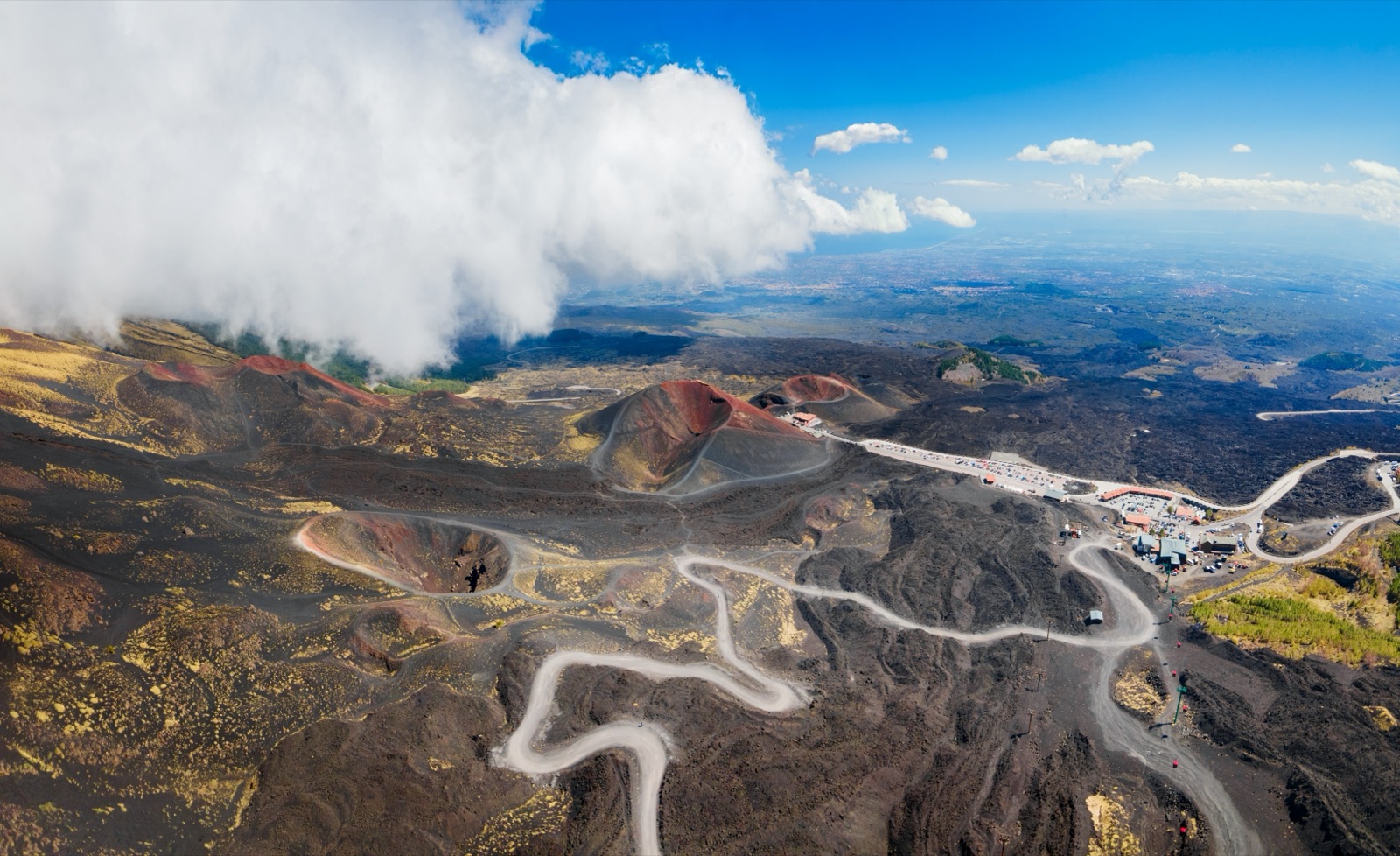
The Silvestri craters beside Rifugio Sapienza formed in the eruption that began on 9 July 1892, which lasted about 173 days and ended on 29 December. They are named after Orazio Silvestri, a scientist who studied Etna, and the SP92 runs between the two main cones. Drive up the south side and you pass straight through the crater row of 1892.
1928: the destruction of Mascali
On 2 November 1928 a system of fissures opened on Etna’s north-eastern flank. The lowest of them fed a flow that headed for Mascali, a town of about 3,000 people on a hill at 120 m. The town was evacuated on 5 November; on 6 November the lava cut the Circumetnea railway, and between 6 and 7 November it buried Mascali.
By the time the eruption ended, in the night of 19 November, about fifty million cubic metres of lava had come out in 17 days and the flow was 9.4 km long. INGV describes it as the only eruption since the eighteenth century to have destroyed a town on Etna.
1991–1993: saving Zafferana Etnea
The longest Etna eruption of the twentieth century began in the night of 13–14 December 1991, when a fracture opened at the base of the South-East Crater. The Civil Protection Department counts 473 days and more than 300 million cubic metres of lava; INGV’s summary gives 472 days. The lava headed for Zafferana Etnea.
Between January and May 1992 the authorities tried measures never attempted before on an erupting volcano. An earth barrier 20 metres high was built to slow the flow, and when the basin behind it filled, the lava was diverted into an artificial course by dropping concrete blocks into its channel and using explosives. The operation worked, and the last active flow was seen on the morning of 30 March 1993.
2001: lava at Rifugio Sapienza
The 2001 eruption is regarded as the first on Etna to be monitored and studied with a fully modern, multidisciplinary approach. It followed 64 lava-fountain episodes at the South-East Crater between January and August 2000, and in the days up to 17 July 2001 INGV’s network recorded more than 2,600 earthquakes.
The eruption ran from 17 July to 9 August 2001, and it hit the south side’s tourist area directly. On 18 July the lava front invaded the square at Rifugio Sapienza and cut the SP92. On 26 July another flow destroyed a ski lift and three pylons of the Etna cable car.
2002–2003: the end of old Piano Provenzana
Just over a year later the volcano erupted on two sides at once. In the night of 26–27 October 2002 vents opened along the North-East Rift and on the south flank. On the north side the lava wiped out the whole tourist station of Piano Provenzana, destroyed about 250 hectares of old pine and oak woodland and stopped only 5 km from Linguaglossa.
The eruption continued into 2003 with months of explosive activity and ash fall. The Civil Protection Department recalls protective masks being handed out and roofs, streets and motorways being cleared of ash, and INGV notes that Catania airport often had to close. Today the 2002 craters are among the most visited sights on the north side.
2021–2026: paroxysms and a very active summer
The 2021 series of about 50 paroxysms made the South-East Crater the highest point on the mountain. In July–August 2024 it was the Voragine’s turn, with large paroxysms of its own. During the paroxysm of 2 June 2025, part of the South-East Crater’s flank collapsed and sent a pyroclastic flow down the mountain in front of thousands of people and their cameras, a reminder of why the summit zone is closed to independent walkers.
Summer 2026 was one of the busiest periods in years. INGV’s account describes a first eruptive episode at the Voragine on 5–7 July 2026 and several more after it; the third, from 6 to 15 August, opened fissures in the Valle del Bove. At least 9 vents opened in the upper eastern sector, and INGV estimated that between 7 and 17 August they poured out between 5.6 and 7.6 million cubic metres of lava. The ash was blown over the south of the volcano and caused serious problems at Catania airport, where many visitors’ flights were moved or cancelled.
September brought more of the same. INGV’s notices for aviation switched repeatedly between orange and red, and Reuters reported on 28 September 2026 that Catania airport had reopened after three days of stoppage. On 29 September, the volcano guides’ monitoring update reported ash from the North-East Crater and irregular explosions at the Bocca Nuova. If you are reading this later, assume the picture has changed and check the current state before you go.
How the volcano is watched
The monitoring is run by the Osservatorio Etneo, INGV’s Catania section. The Civil Protection Department lists the main tools: a network of seismic stations on the middle and upper slopes; surveillance cameras working in visible light and in the thermal infrared on the eastern and southern flanks; and satellite images from Meteosat and the Cosmo-SkyMed radar constellation, which can see the volcano even under cloud. Inside the UNESCO World Heritage area alone there are over 50 small seismic monitoring stations.
The Department describes the system as among the most advanced in the world, normally able to forecast the start of an eruption well in advance. That applies above all to flank eruptions, which are usually preceded by clear swarms of earthquakes that show where the vent will open, as the 2,600-plus earthquakes before the 2001 eruption did.
INGV publishes weekly bulletins, communiqués during events and notices for aviation, and the Civil Protection Department sets the national alert level (green, yellow, orange or red). The Department warns that some of Etna’s phenomena are sudden and unpredictable, so the risk is never absent even at green. Our article on Etna webcams and volcano alerts explains how to read each of them before a trip.
What an eruption means for a visit that day
The upper mountain may be closed
The summit zone is guided-only even on a quiet day. Since August 2010, ordinances of the Prefecture of Catania have closed it to independent visitors from 2,920 m at Torre del Filosofo on the south side and from 2,990 m at Punta Lucia on the north side, and visits to the summit craters must be accompanied by qualified alpine or volcanological guides. Our guide to the cable car, the 4x4 and the summit rules sets out what you can do on your own.
When activity rises, the rules tighten. Sicily’s regional civil protection works with four local operating phases (base, attention, pre-alarm and alarm). In the attention phase mayors regulate access to the summit zone by ordinance, and in the pre-alarm and alarm phases they close it. A real example: on 25 August 2025, with lava flowing on the south flank, the mayor of Belpasso ordered everyone to keep at least 50 metres from the lava and kept the yellow zone near the summit closed.
Guides and operators adjust on the day: the Etna guides’ own FAQ says that in bad weather or high volcanic activity, excursions are changed or cancelled for safety. That is why keeping the day flexible matters more than the time of year you choose.
Ash and flights
Ash travels much further than lava. The Civil Protection Department lists heavy disruption to air traffic and to Catania Fontanarossa airport among the main effects of ash fall. In August 2026, ENAC, Italy’s civil aviation authority, reported that ash and mainly southerly winds had led to the total closure of the airspace serving Catania, with flights cancelled or moved, mostly to Palermo. Its advice is simple: check the status of your flight before you go to the airport.
In an active period, do not put Etna, or your flight home, on the last day of a tight itinerary, and choose tours whose cancellation terms cover volcanic closures.
Can you see lava?
Sometimes, but never on your own terms. It depends on where the lava is flowing and what the ordinances allow that day; when flows can be approached, guided groups are the way in, at the distance the ordinances set. A guided hike towards the summit area, when it is allowed, is the closest most visitors get to an active vent.
If there is nothing to see at the top, past eruptions are all around you: the sunset jeep tour from Catania visits old eruptive vents and a lava-flow cave before sunset at about 2,000 m, with no need for the summit to be open.
Where to see Etna’s past eruptions
- The Silvestri craters (1892), beside Rifugio Sapienza. Free, a short walk from the car park, and the easiest way to stand on a real crater rim.
- The Monti Rossi (1669), just north of Nicolosi. From the top you look over the land crossed by the lava that reached Catania.
- Castello Ursino in Catania (1669). The lava of 1669 topped the city walls here and poured into the castle moat.
- The cable car above Rifugio Sapienza (2001), whose pylons were destroyed by lava in 2001.
- Piano Provenzana and the 2002 craters, on the north side. A walk of about 1.5 hours from Piano Provenzana reaches the craters that destroyed the old tourist station; our article on Etna tours from Taormina covers the north side in more detail.
Frequently asked questions
Is Mount Etna erupting now?
Etna was very active through the summer and autumn of 2026, with eruptive episodes at the Voragine from July and notices for aviation switching between orange and red in late September. Activity changes from day to day, so check INGV’s latest communiqués and the Civil Protection alert level shortly before you travel.
What was Etna’s biggest eruption?
The largest flank eruption in its recorded history was in 1669. Lava ran up to 17 km from the vent, reached the sea and entered Catania, and the eruption lasted four months. INGV notes that it killed no one.
Is it safe to visit Etna during an eruption?
Visiting is managed rather than banned. The summit zone is guided-only at all times, mayors can close it by ordinance when the operating phase rises, and guides change or cancel excursions when activity is high. Stay within what is open on the day and follow your guide.
Does an Etna eruption close Catania airport?
It can. Ash falling on the runways or carried towards the airport can suspend flights, as happened for three days in late September 2026. Whether it closes depends on the ash and the wind, so check your flight with the airline before leaving for the airport.