Etna Wine Tasting: Wineries, Grapes and Wine Tours on the Volcano
The easiest way to taste Etna wine is to visit a winery on the volcano’s lower slopes, either on your own by car or on an organised wine tour that handles the driving. The north side, around Linguaglossa, Castiglione di Sicilia and Randazzo, has the most producers; the east and south-east slopes, above the Ionian coast, are closer to Catania. Two regular tours run by the Strada del Vino dell’Etna make it simple without a car: a Wine Train from Linguaglossa on Thursdays and Saturdays from March to November, and a Wine Bus from Catania on Wednesdays and Sundays from April to December.
This guide explains what Etna DOC wine is, which grapes and slopes to look for, how the tours work, and how to fit a tasting into a day on the volcano.
Why Etna wine is different
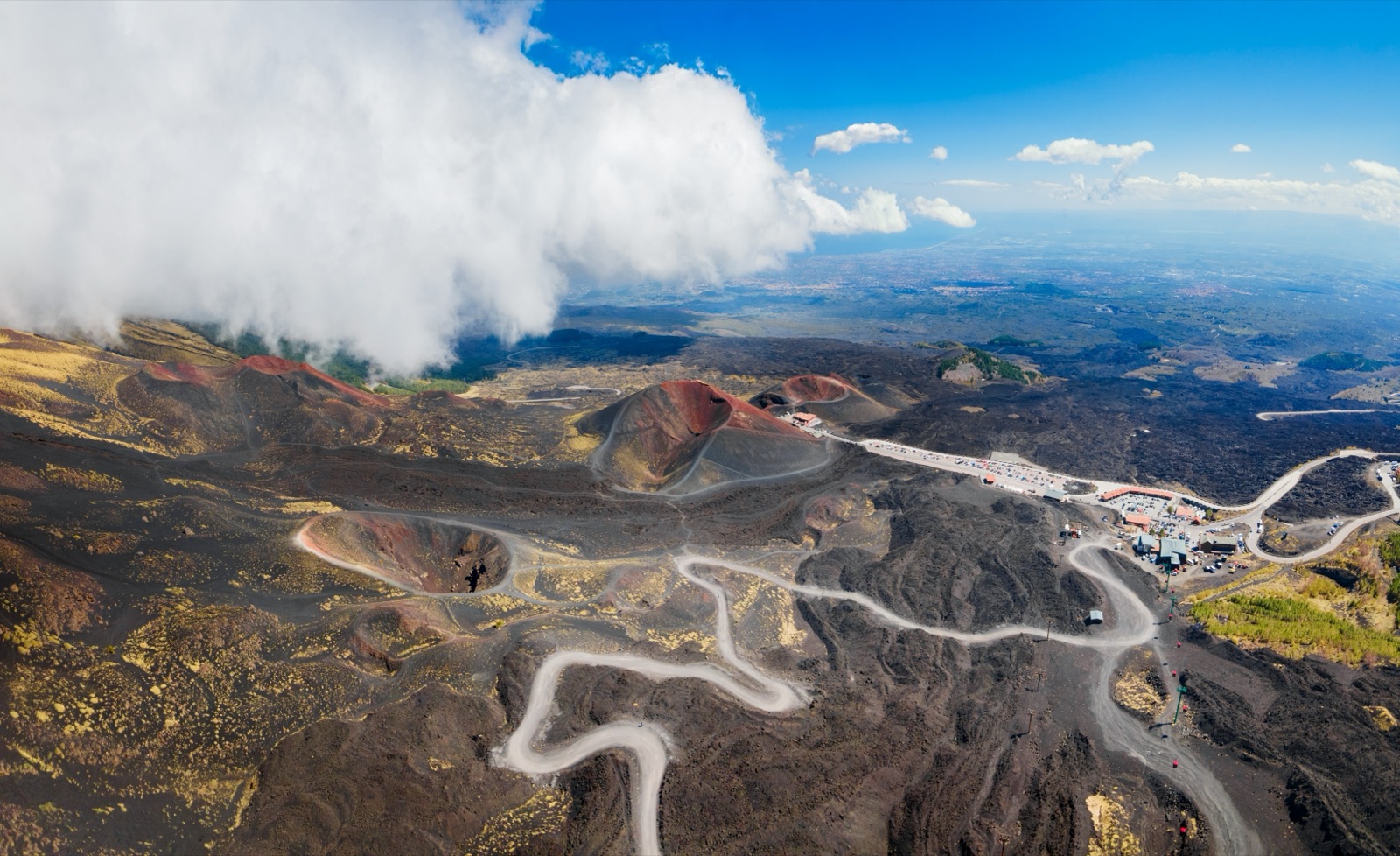
Etna’s wine region is unusual in almost every way. The vines grow on the slopes of an active volcano, often on narrow terraces held up by walls of black lava stone. The Etna DOC consortium says that on Etna’s terraces “heroic viticulture” finds one of its most iconic expressions, because eruptions have shaped steep, broken ground that is hard to work.
Three things shape the wines:
- Volcanic soil. Pebbly, gravelly, sandy or ashy, and the source of the mineral character the consortium describes as distinctive.
- Height and cold nights. Day–night temperature differences can reach 20–25°C, which keeps the grapes fresh and aromatic.
- Old, ungrafted vines. Some Etna vineyards are more than a century old and often ungrafted, because the volcanic soils kept phylloxera out.
The consortium sums up the appellation in four numbers: 7 wines, 20 villages, 133 contrade and 3,000 years of viticulture.
A very short history of wine on Etna
Wine on Etna is old. The Greeks colonised this part of Sicily in 720 BC, and wine production probably developed as early as the 8th century BC. The industry later grew enormously:
- In 1848 almost 26,000 hectares were under vine.
- Between 1880 and 1885 Catania was Sicily’s province with the most vineyards, over 90,000 hectares.
- With phylloxera in the early 1900s, the vineyard area fell to about 40,000 hectares.
Modern Etna wine dates from 1968, when the Etna DOC was established, the first in Sicily and one of the first in Italy. The consortium protecting Etna wines was created in January 1994. Today it counts 509 producers, 43,700 hectolitres of wine, 5.8 million bottles and 1,461 hectares.
That last figure is the one to remember: Etna is a small wine region, with a lot of small producers. Many wineries are family businesses, which is a big part of the appeal of a visit.
The grapes
Four native grapes make almost all Etna DOC wine. Nerello Mascalese, Nerello Cappuccio, Carricante and Catarratto are the main native varieties.
Nerello Mascalese
The red grape of Etna, and the main variety of Etna Rosso, Etna Rosso Riserva, Etna Rosato and Etna spumante. It ripens late, in the second ten days of October, and is often compared with Nebbiolo for that late ripening and with Pinot Noir for its sensitivity to place. The consortium describes its wines as ruby, with high acidity, minerality and great finesse.
Nerello Cappuccio
The second red grape, always in blends where Nerello Mascalese is predominant. Its name comes from the cape-like shape of its leaves, which shelter the fruit from sun and wind. It adds deeper colour and softer, spicier notes.
Carricante
The white grape of Etna and the backbone of Etna Bianco. Its name comes from the Sicilian “u carricanti”, for vines productive enough to fill wagons. It is harvested between the end of September and the beginning of October, and its natural home is the cool eastern slope facing the sea.
Catarratto
An old Sicilian white grape, allowed in Etna Bianco and Bianco Superiore in blends where Carricante is always predominant. It is less common on the volcano than it once was.
The Etna DOC wines on the label
When you taste, these are the names you will see:
| Wine | What is in it |
|---|---|
| Etna Bianco | At least 60% Carricante, up to 40% Catarratto |
| Etna Bianco Superiore | Carricante alone or at least 80% |
| Etna Rosso | At least 80% Nerello Mascalese, up to 20% Nerello Cappuccio |
| Etna Rosato | As Etna Rosso |
| Etna Rosso Riserva | As Etna Rosso, with at least four years of ageing, one of them in wood |
| Etna spumante | Sparkling, based on Nerello Mascalese |
You will also see a place name on many bottles. The production area is divided into 133 contrade, small countryside districts that reflect differences in soil, and producers can name them on the label. Tasting two wines from different contrade side by side is one of the best ways to understand Etna.
How to taste Etna wine: a simple flight
Most winery tastings on Etna pour two to four wines. If you have a choice, a flight that moves from white to red, and from one slope to another, teaches you the most in the least time:
- Start with Etna Bianco. Carricante’s home is the cool eastern slope, and the consortium describes the pure wine as straw yellow, with hints of citrus flowers and white-fleshed fruit and an exceptional minerality. Notice how fresh it is: that is the cold nights at work.
- Then a Bianco Superiore if it is offered. Carricante alone or at least 80%, so the grape’s character comes through more clearly.
- Move to Etna Rosato. Made from the same grapes as Etna Rosso, and a useful bridge between the whites and the reds.
- Then Etna Rosso. Mostly Nerello Mascalese. Look for acidity, minerality and fine tannins rather than weight.
- Finish with a Riserva or a single contrada. A Riserva has spent at least four years ageing, one of them in wood. A wine named after a contrada shows how much one district can differ from the next.
Two habits make a tasting more useful. Ask which slope and roughly what height the vineyard is on, because that explains more about an Etna wine than almost anything else. And ask whether the vines are old bush vines on lava terraces; on Etna, the answer is often yes.
If you are driving, use the spittoon. Tasting rooms are used to it, and the mountain roads home are not the place for a second glass.
The four wine slopes
Etna is round, so its vineyards face every direction, and each side makes different wine. The consortium describes four slopes:
- North. The area with the most producers and the gentlest gradients. It is cold but sheltered by the mountains behind it, and Nerello Mascalese is the main grape. This is the slope around Linguaglossa, Castiglione di Sicilia and Randazzo.
- East. Facing the Ionian Sea, the wettest and windiest side. Bush vines grow on small terraces up to 900 m, and white Carricante dominates. Milo and Zafferana Etnea are on this side.
- South-east. Dotted with extinct cones, with bush vines where Nerello Mascalese and Carricante ripen well. It is the closest wine country to Catania.
- South-west. The furthest from the sea, drier and hotter, where Nerello Cappuccio and Carricante can grow above 1,000 m.
The most common training system is the traditional bush vine, the alberello, with vines climbing the slopes on black lava-stone terraces. Even if you do not taste a drop, the terraces are worth the drive.
The Strada del Vino dell’Etna
The Strada del Vino dell’Etna is an association that brings together wineries, farms, places to stay and restaurants around the volcano. Its tours are run by a partner tour company, and they are the simplest way to visit wineries without driving. Three formats stand out.
The Etna Wine Train (from Linguaglossa)
This is the one people remember. You ride the narrow-gauge Circumetnea railway across the north side of the volcano, then a Wine Bus takes you to two wineries and a historic village.
The day, as published by the association:
| Time | What happens |
|---|---|
| 9:15 | Meet the guide at Linguaglossa’s Circumetnea station |
| 9:28 | The train leaves Linguaglossa |
| 10:05 | Arrival at Randazzo station and a visit to the old town |
| 12:00 | First winery: two wines and local produce |
| 14:00 | Second winery: two wines and local produce |
| 16:00 | Return and end of the tour |
What the ticket includes:
- a one-way Circumetnea train ticket;
- a guide;
- Wine Bus transfers to 2 wineries and a historic village (Castiglione di Sicilia or Randazzo);
- 2 tastings, each with 2 glasses of Etna DOC and a plate of local produce;
- the Wine Bus back to the starting station.
Bookings are for Thursdays and Saturdays, from March to November. Departures are only from Linguaglossa. If you are not driving, you can come by regional train to Giarre, and a return transfer from Giarre–Riposto station to Linguaglossa costs €50, not per person but shared by up to 5, paid in cash to the driver. After the tour, the permanent exhibition at the Museo Salvatore Incorpora in Linguaglossa is free to visit.
The Etna Wine Bus (from Catania)
If you are staying in Catania, this is the easier option, because it starts in the city. The bus leaves at 9:00 from Piazza Scammacca, 9:10 from Piazza Stesicoro and 9:20 from Catania Centrale station, follows the coast past Aci Castello and Aci Trezza, then climbs to the south-east slope among vineyards and olive groves.
The ticket includes return bus travel, a guide in Italian or English, visits to 2 wineries with 2 Etna wines tasted at each and a plate of local produce, and the transfer back to your Catania stop. Wineries come at 12:00 and 14:00, with the return at 16:00.
It runs on Wednesdays and Sundays from April to December, and for groups of more than 10 it runs any day of the week. No wine or alcohol is served to minors.
Etna Trekking & Wine Tour (from Piano Provenzana)
For people who want the volcano and the wine in one day, this tour meets at Piano Provenzana on the north side and runs 09:00–16:00, 7 hours in all. The walk covers altitudes between about 1,800 m and 2,100 m, among side craters and old lava flows, with helmets and torches provided. It ends at a winery with 3 glasses of Etna DOC, a plate of local produce and a dish of Sicilian pasta.
The organisers note that mid- and high-altitude excursions are not suitable for people with heart or breathing conditions.
Booking rules for the Strada del Vino tours
The train and bus tours share the same rules, and they are stricter than most:
- Book at least 48 hours ahead. Tickets bought less than two days before are not validated.
- Cancellation. Cancelling up to 7 days ahead is free; from 6 to 2 days ahead 50% is kept; the day before or a no-show loses the full price.
Check the dates on the association’s own page before you plan around a tour, because the programme can change from season to season.
Visiting wineries on your own
You can also plan your own winery visits. The Strada del Vino dell’Etna lists its member wineries, and booking ahead is the safe assumption. A few practical points if you are driving yourself:
- Pick one slope. The north side is the densest wine country. Distances on Etna look short on a map, but mountain roads are slow, and the two sides of the volcano are about 42 km apart and not directly linked.
- Do not drink and drive. Someone has to drive the hairpins. A tour with transport solves this.
- Combine with a village. Randazzo is known as the “city of a hundred churches”, with a medieval centre built of lava stone, sandstone and limestone. Castiglione di Sicilia, high over the Alcantara valley, is listed among the Borghi più belli d’Italia and has the Castello di Lauria.
The park’s figures put Linguaglossa at 550 m and 44 km from Catania, Castiglione di Sicilia at 601 m and 59 km, and Randazzo at 765 m and 69 km. On the east side, Milo is at 720 m and 26 km from Catania, and Zafferana Etnea at 574 m and 20 km. Our where is Etna guide has the full table of towns.
Combining wine with the volcano
A wine tasting fits naturally after a morning on the mountain, because the upper slopes are best early. The sky over Etna is often clearer early in the day, with cloud forming in the afternoon, so go up first and taste later.
Some ways to put a day together:
- South side and east-slope wine. Take the cable car from Rifugio Sapienza in the morning, then drive down towards Zafferana Etnea or Milo for an afternoon tasting.
- North side and the Wine Train. Stay near Linguaglossa, do the Wine Train on a Thursday or Saturday, and spend another day on the 2002 craters walk from Piano Provenzana.
- A tour that includes tastings. The sunset jeep tour from Catania includes local tastings in Zafferana Etnea before sunset at about 2,000 m, and the Etna and Taormina day tour from Catania includes a taste of local produce. The Etna and Alcantara full day includes lunch at a local restaurant. All three are on our tours page.
If you are planning around the weather, the Etna weather page shows the forecast for the upper stations; vineyards on the lower slopes can be warm and sunny while the summit is in cloud.
When to go for wine
You can taste Etna wine all year, but the season changes the experience:
- Harvest. Carricante is picked between the end of September and the beginning of October, and Nerello Mascalese in the second ten days of October. Harvest is the liveliest time in the vineyards.
- The tour season. The Wine Train runs from March to November, and the Wine Bus from April to December.
- Winter. The Wine Train is outside its season and the Wine Bus stops after December, so a winter tasting means arranging a winery visit yourself or joining a volcano tour that includes local tastings.
For the volcano itself, our when to visit Etna guide covers the seasons and what to wear on the upper slopes.
Frequently asked questions
What wine is Etna famous for?
Etna Rosso, made mainly from Nerello Mascalese, and Etna Bianco, made mainly from Carricante. Both come from the Etna DOC, established in 1968 as the first DOC in Sicily.
Can you do an Etna wine tour without a car?
Yes. The Etna Wine Bus starts in central Catania, and the Etna Wine Train starts at Linguaglossa, which you can reach by train to Giarre and a shared transfer.
Which side of Etna has the most wineries?
The north side. The consortium describes the northern slope as the area with the most producers and the gentlest gradients.
Can children come on the wine tours?
Families can join, but no wine or alcohol is served to minors on the Wine Bus.