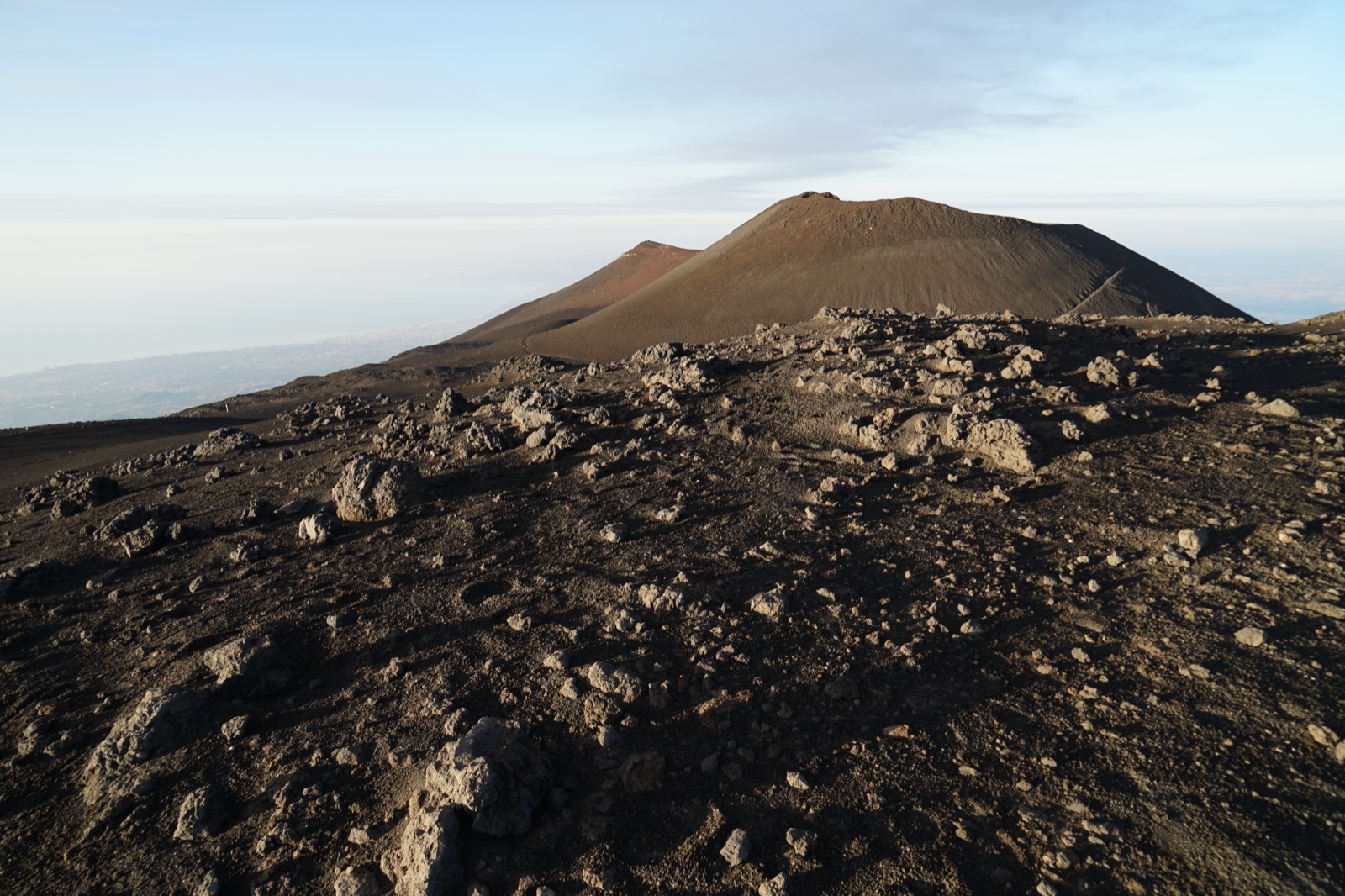
Etna's Lava Caves: Grotta del Gelo, Lamponi, Serracozzo and How to Visit
Mount Etna is full of caves, but they are not limestone caverns. Almost all of them are lava tunnels: channels where molten rock kept flowing under a cooled crust and then drained away, leaving a hollow tube. The easiest way to see one is on a guided tour that includes a cave stop with helmets and torches, such as the sunset jeep tour from Catania. If you want to go further, the Etna Park’s trails lead to several named caves you can reach on foot, including the Grotta del Gelo, which holds ice all year round.
This guide covers the caves worth knowing, with the park’s own measurements, the trails that reach them, what to bring, and the tours that include a cave.
How Etna’s lava caves form
A lava flow cools from the outside first. Its surface and edges harden into a crust, while the lava inside, insulated by that crust, keeps moving. When the eruption stops feeding the flow, the molten core can drain downhill and leave an empty tunnel behind. The park calls these “gallerie di scorrimento lavico”, lava-flow galleries.
Inside you will often see the marks of that last flow:
- Horizontal grooves and ledges on the walls, where the lava stood at different levels.
- Remelt stalactites, small drips of rock that formed when hot gases remelted the roof.
- Collapses, where parts of the roof have fallen in, often making the openings you climb through.
Not every Etna cave is a pure tube. The Grotta di Serracozzo, for example, is partly a lava tunnel and partly a fissure, and the park describes its keyhole shape.
The caves at a glance
| Cave | Height | Length | Drop | Getting there |
|---|---|---|---|---|
| Grotta del Gelo | 2,030 m | 125 m | 30 m | Trail 726 (high grade, EE) |
| Grotta dei Lamponi | 1,750 m | 400 m | 10 m | Start of trail 726 |
| Grotta di Serracozzo | About 1,830 m | About 350 m | – | Trail 723 from Rifugio Citelli |
| Grotta del Burrò | 1,225 m | 240 m | 5 m | Park trail network, west side |
| Grotta delle Palombe | About 1,570 m | About 40 m and 80 m galleries | Entrance shaft 13 m deep | Trail 720 |
| Grotta dei Ladroni | About 1,200 m | Single chamber | – | Old mule track from Fornazzo |
All figures are from the Etna Park’s own cave and trail pages.
Grotta del Gelo: the ice cave
The Grotta del Gelo is Etna’s best-known volcanic cave, famous for one thing: perennial ice, unusual at this latitude and in sharp contrast with the dry lava field around it. It is a lava-flow tunnel 125 m long, with a drop of 30 m, at 2,030 m.
The cave lies in lava from an eruption that lasted ten years, from 1614 to 1624. It opens in a hollow that stays filled with snow until late spring. In the warm season a wide puddle forms at the entrance, leading to a steep icy slope. Inside, ice stalactites and stalagmites form in different amounts through the year, sometimes joining into columns. Since 1997 its microclimate has been monitored by the park and the Centro Speleologico Etneo.
Getting to the Grotta del Gelo
The classic route is the park’s trail 726, from the Grotta dei Lamponi to the Grotta del Gelo. The park lists it as 3.35 km with a maximum climb of 325 m, 2–3 hours, and grades it high (EE), the grade reserved for experienced hikers. It is reached by a path that leaves trail 701 at 1,707 m, at Passo dei Dammusi, so the approach itself is long.
The park gives April–May as the best time for the walk. Remember that the floor inside is ice: going in safely needs proper footwear and, realistically, someone who knows the cave. Most visitors are best off going with a guide.
Grotta dei Lamponi: one of the longest
The Grotta dei Lamponi, at 1,750 m on the north-western side, runs 400 m with a drop of 10 m and is one of Etna’s longest lava-flow tunnels. It sits at the start of trail 726, the historic route to the ice cave.
You enter through an opening in the roof, down a steep slope of fallen debris. Inside there are two galleries:
- Below the entrance, about 100 m long, with many collapses.
- Above the entrance, 300 m long and better preserved.
Remelt stalactites are found throughout, along with grooves on the walls. The many openings make it very draughty.
The winter trek to the Grotta dei Lamponi
From about November to March, a guided winter trek runs from Piano Provenzana (1,800 m) to the Grotta dei Lamponi, with or without snow. It is a serious day: 11 km, 500 m of climb and 5–6 hours, in groups of 6–12, with a helmet and head torch included. Meeting is at 08.00 for an 08.30 start.
It costs €50 a person, plus €15 for snowshoes and poles if needed. It needs at least 6 participants and is for over-12s in good shape. On the way it passes the 2002 lava and hornitos, small chimneys built by degassing lava.
Grotta di Serracozzo: the cave on a classic day hike
The Grotta di Serracozzo is the cave you are most likely to see on a proper day’s walk. It opens at about 1,830 m in the first part of the 1971 lava flow, among birch, chestnut and pine at the edge of the woods. Partly a lava tunnel and partly a fissure, it is about 350 m long and 2–3 m wide.
It is on the park’s trail 723 from Rifugio Citelli, which starts just 100 m before the refuge. After about 20 minutes on the trail you reach the cave. The park’s advice is specific: the entrance is small and needs care, and only people with helmets and torches should go in, for about 50 m.
The full trail continues to a viewpoint over the Valle del Bove at 2,095 m. It is 8 km with a maximum climb of 1,080 m, 5–6 hours, graded medium-high (E). Our Etna hiking guide has more on this walk.
Grotta del Burrò
The Grotta del Burrò is a wide lava-flow tunnel at 1,225 m, 240 m long with a drop of 5 m and a roof more than 3 m high. It opens at the bottom of an oval hollow full of vegetation, through three openings, of which the central one is the widest and easiest.
Inside, the floor is covered with fallen blocks and rough lava. Halfway along there is a small raised chamber, and near the end the tunnel splits into two smaller parallel galleries that rejoin further down. The left-hand branch is narrow with a muddy floor. It is a good example of how varied the inside of one lava tube can be.
Grotta delle Palombe
The Grotta delle Palombe lies at about 1,570 m on trail 720, part of the CAI Sentiero Italia. You enter down a shaft 6 m wide and 13 m deep, walking down the south wall over fallen rocks and debris.
From the bottom, the gallery runs in two directions:
- Upstream, about 40 m, to a round collapse chamber 7 m across.
- Downstream, about 80 m, much of it over muddy fallen blocks and down a steep, slippery slope.
The name means “cave of the doves”, after the flocks of pigeons that once nested there; a few bats have been seen inside. With a vertical entrance and slippery mud, it is for people with caving experience.
Grotta dei Ladroni: the snow store
The Grotta dei Ladroni lies at about 1,200 m on the old mule track from Fornazzo towards Rifugio Citelli. It has four openings, and the westernmost has steep steps cut into the rock. Inside it is a single, fairly well-preserved chamber, high enough to stand up in throughout.
Its history is the best part. The cave was used to store winter snow, which was taken down in summer to Catania, other Etna towns and even Malta, for keeping food cold, making ice cream and cooling patients before surgery. Its name, “the thieves’ cave”, comes from the legend of brigands lying in wait there. The French traveller Jean Houel drew it at the end of the 18th century.
Caves on the easy trails
You do not have to hike for hours to see a lava tube. The park’s trail 782, Monte Nero degli Zappini, is a 3 km loop with a maximum climb of 130 m, taking about an hour and graded low (T). Along the way it crosses old and recent lava fields (1985–2001), lava-flow caves and hornitos. The caves along it are the Grotta Gussonea, which is closed, and the Grotta di Santa Barbara.
Some caves near the roads are closed for safety, and trails the park marks as not in service are closed to the public. Respect the closures: lava tube roofs collapse.
Lava caves on organised tours
For most visitors, a cave stop on an organised tour is the simplest and safest way in, because the guide brings helmets and torches and knows which caves are safe. Tours that include a lava cave:
- Sunset jeep tour from Catania. A guided jeep or van tour of the park with old explosive vents, a lava-flow cave with helmet and torch, local tastings in Zafferana Etnea and sunset at about 2,000 m. It lasts 5–5.5 hours.
- Quad tour on the lower slopes. A guided ride of about 20 km through lava channels and black sand, with a stop at a volcanic cave. It lasts about 2 hours.
- Etna and Taormina in one day. A van tour of the slopes with a volcanic cave, a walk on an old crater rim and a taste of local produce, then an afternoon in Taormina.
- Etna and the Alcantara Gorges. Etna’s northern slope by off-road vehicle, with the 2002 lava front, the Sartorius craters and a lava cave, then the Alcantara lava canyon.
You can compare them on our Etna tours page. The Etna Trekking & Wine Tour from Piano Provenzana also provides helmets and torches; it is covered in our Etna wine guide.
Planning a cave day: four ways to do it
How you see Etna’s caves depends on how much time, fitness and transport you have. Four realistic plans:
No car, half a day: a tour from Catania
The simplest option. The sunset jeep tour picks up in Catania, stops at a lava-flow cave with helmets and torches provided, and ends with sunset at about 2,000 m. You see a cave safely, and you do not need to find it, drive to it or bring any kit beyond warm clothes and good shoes.
A car and a couple of hours: Monte Nero degli Zappini
Drive up from Nicolosi towards Rifugio Sapienza and walk the park’s 3 km nature loop from the plateau west of Monte Vetore. It passes lava-flow caves and hornitos in about an hour. Combine it with the Silvestri craters beside Rifugio Sapienza, where a 20-minute walk brings you to the rim of the upper crater.
A full day on foot: Serracozzo
Drive to Rifugio Citelli on the north-east side and walk trail 723. The cave comes after about 20 minutes, so even a short outing reaches it; carry on to the viewpoint over the Valle del Bove at 2,095 m if you have the legs for 5–6 hours. Bring a helmet and a torch if you plan to go inside.
Winter: the Lamponi trek
Between about November and March, join the guided trek from Piano Provenzana to the Grotta dei Lamponi. It is long, at 11 km and 5–6 hours, but the guide provides the helmet and head torch and handles the route in snow.
What to bring into a lava cave
Lava caves are cold, dark, rough and often wet. The basics:
- A helmet. Low roofs and loose rock make one essential; tours provide them.
- A torch, ideally a head torch, plus a spare. Keep your hands free for scrambling.
- Sturdy boots. The floor is usually broken lava, fallen blocks or mud, and in the Grotta del Gelo, ice.
- Warm layers. Even in summer, the inside of a cave at height is cold.
- Gloves. Lava rock is sharp.
Never go into a cave alone, and tell someone where you are going. In an emergency, call 112, the European emergency number.
Respecting the caves
Etna’s caves are part of a protected area. The volcano’s high ground is a UNESCO World Heritage site, and the Etna Park divides its land into zones with different levels of protection. A few simple rules keep the caves as they are for the next visitor:
- Touch as little as possible. Remelt stalactites, wall grooves and ice formations are fragile and do not grow back.
- Take nothing. Not a fragment of lava, not a piece of ice.
- Leave nothing. Carry out every wrapper and every spent battery.
- Keep noise down. Some caves shelter bats.
- Stay out of closed caves. A closure usually means the roof or the entrance is unstable.
Cave conditions also change with the volcano. New lava can bury an entrance, and earthquakes can bring down a roof, so a cave described in an old guidebook may not be open today. Check the park’s own trail and cave pages before you go.
When to visit Etna’s caves
Most of the lower caves can be visited all year, but the season changes the approach:
- Spring. The park recommends April–May for the walk to the Grotta del Gelo. Snow lingers in the hollow at the cave’s mouth until late spring.
- Summer. The easiest time for the high trails, but go early: cloud often forms on Etna in the afternoon.
- Winter. Snow covers the high caves and the approach trails. The guided trek to the Grotta dei Lamponi is the main winter option; our skiing and snow guide covers other winter activities.
Check the forecast for the altitude you are heading to on our Etna weather page before you set out, and remember this is an active volcano: in bad weather or high volcanic activity, excursions are changed or cancelled for safety.
Frequently asked questions
Can you visit lava caves on Etna without a guide?
Some caves are on the park’s public trails, and the park describes them in detail. But caves need helmets, torches and experience, and some are closed for safety. For most visitors, a guided tour is the better option.
What is the ice cave on Etna?
The Grotta del Gelo, a lava tunnel at 2,030 m that holds ice all year round. It is reached by the park’s trail 726, graded high (EE).
Which tour includes a lava cave?
The sunset jeep tour from Catania includes a lava-flow cave with helmet and torch. The quad tour, the Etna and Taormina day tour, and the Etna and Alcantara day tour also include a cave stop.
How long is the Grotta dei Lamponi?
The park describes the Grotta dei Lamponi, at 400 m long, as one of Etna’s longest lava-flow tunnels.